When a mature tree develops a major structural defect, many homeowners assume removal is the only safe option. In reality, that’s not always the case. In some situations, tree cabling and bracing can provide the structural support needed to reduce the risk of failure while preserving a healthy, valuable tree.
For mature trees, that can make all the difference. A large oak, maple, or beech that has shaded your property for decades can’t simply be replaced. When a tree can be safely retained, cabling and bracing may extend its life for many years while helping protect your home and family.
Key Takeaways
- Tree cabling uses flexible steel cable high in the canopy to reduce movement at weak unions, while bracing uses rigid rods lower in the tree to reinforce cracks or splits.
- The two systems are often installed together: the cable limits upper-canopy stress while the brace rod holds the weak union steady.
- Cabling works on otherwise healthy trees with identifiable structural defects but cannot fix severe decay, root failure, or a tree past saving.
- The cable-or-remove decision comes down to four factors: tree health, structural integrity at the anchor points, risk level, and what the tree could potentially hit if it failed.
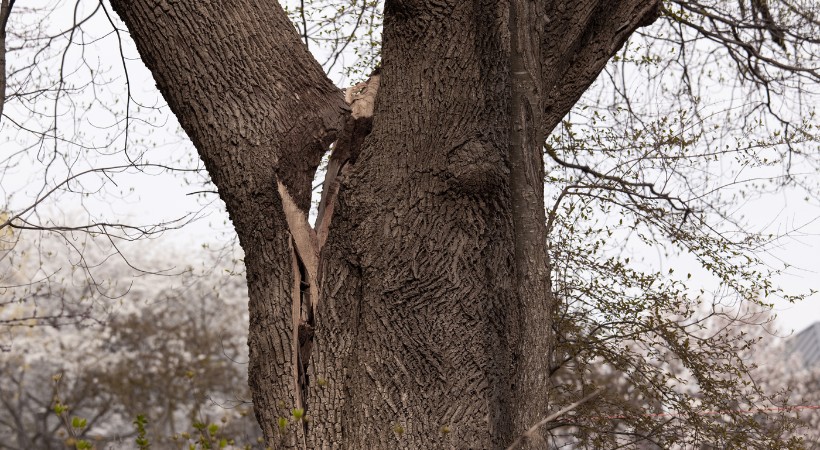
Structural defects like this split union are common in older oaks throughout the greater Baltimore area and often develop without warning until a storm exposes the weakness.
Why Do Mature Trees Develop Structural Weakness?
Most structural weaknesses in mature trees are tied to how the tree grew when it was young, not a sudden problem. By the time a homeowner notices it, the tree is usually 40 to 80 feet tall and has carried that weakness for decades.
Co-Dominant Stems
Co-dominant stems form when two or more vertical stems grow from a common point with no central leader. Mechanically, this is weaker than a standard branch-to-trunk attachment because the wood fibers don’t interlock the way they do at a proper union.
It’s especially common in:
- Maples
- Oaks
- Elms
- Tulip poplars
- Many other deciduous trees throughout the greater Baltimore area
Included Bark
Included bark forms when bark gets trapped between two co-dominant stems instead of pushing out into a healthy raised ridge. The result is mechanically similar to a sheet of plywood wedged between the stems.
As each stem thickens every year, they wedge against the trapped bark and the crack drives down into the heart of the tree. This drastically increases the risk for failure during storms.
Long Lateral Limbs and Aging Canopy Weight
As trees mature, vertical growth slows but lateral expansion continues, and individual limbs can outgrow the wood’s ability to support their own weight. Several conditions multiply the stress on long horizontal limbs, including:
- Rain saturation
- Full leaf-out
- Snow
- Ice
White oaks in Maryland reach 80 to 100 feet and decades of canopy accumulation compounds the issue.
How Does Tree Cabling Work?
Tree cabling uses high-strength steel cable installed high in the canopy between major limbs to limit excessive movements at weak unions while still letting the tree naturally flex. The cable doesn’t lock the tree in place; it just limits how far the canopy can swing. This keeps the weak point below from absorbing the full force of a wind gust or ice load.
The part that takes expertise is placement. The cable goes:
- High in the canopy
- Between major stems or limbs
- Where it can redistribute stress, so no single weak point absorbs the whole load
Cables and braces should let a tree flex somewhat so that it will grow stronger over time. They are meant to stop them from bending to the point of breaking, though. That natural flex is what builds and sustains structural wood in the long-term.
From the ground, cables correctly installed are virtually invisible, which matters for homeowners who don’t want to look up and see hardware in their tree. Modern systems are usually dynamic, as they allow some movement instead of locking the canopy. A-AAA offers professional tree cabling and bracing in the greater Baltimore area.
When Is Cabling Appropriate?
Cabling is appropriate and the right call when a tree is otherwise healthy, the defect has been identified before catastrophic failure, and the wood is sound enough to anchor the hardware safely. These conditions matter more than the species or size of the tree. A healthy 60-year-old oak with a clean co-dominant stem is a strong candidate, while a declining tree with the same defect is usually not.
Those baselines aside, cabling makes the most sense when the tree has real value worth preserving, whether that value is a mature canopy, the shade it provides for the house, or its place in the landscape.
When Isn’t Cabling Appropriate?
Cabling isn’t the right choice in a few situations, such as:
- Severe internal decay where hardware cannot anchor safely
- Root failure or significant root system damage, since cabling addresses above-ground structure only
- Limbs already detached or hanging that should be removed rather than braced
- A risk-to-target ratio so high that even a supported tree poses unacceptable danger
PRO TIP: A cabled tree isn’t a one-and-done project. These systems should be inspected from the ground every year, with closer inspection from above every three to five years. Weakened unions should always be reassessed after a storm.
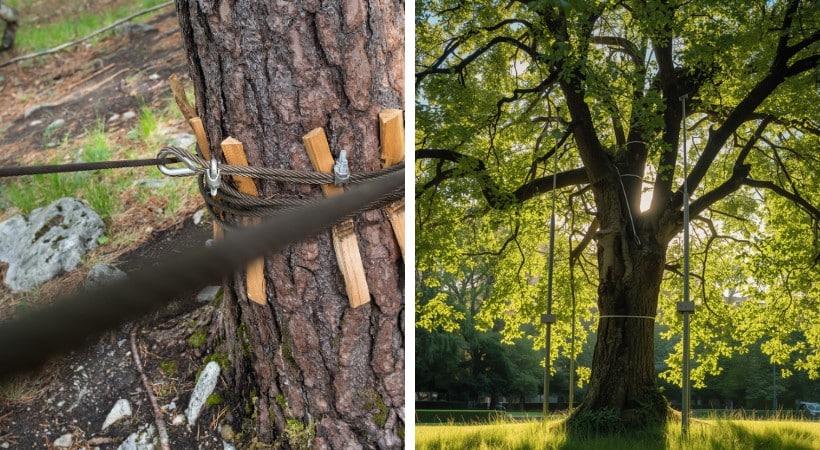
Cabling and bracing systems work together to redistribute stress, with cables limiting canopy movement up high and braces reinforcing weak unions lower in the tree.
How Is Tree Bracing Different from Cabling?
Bracing uses rigid threaded steel rods installed through the trunk or branch union to physically reinforce an active crack or split, while cabling uses flexible cable higher up to limit movement. The two systems do different jobs at different points in the tree, which is why they tend to be paired rather than used as alternatives.
Where Bracing Sits in the Tree
Bracing rods are installed directly through the structural defect, including:
- Split trunks
- Weak branch unions
- Cracked or partially failed limbs
Because the rods reinforce the damaged wood itself, bracing is used when a defect has already developed. Cabling serves a different purpose—it reduces movement in the upper canopy to lessen the forces acting on that weakened area.
When Both Systems Are Used Together
In many cases, a Licensed Tree Expert installs both. The cable limits how much the upper canopy moves, which lowers the pulling force on the weak point below. The brace rod holds the union steady so the crack can’t widen. Together, they evenly distribute the stress during high winds and heavy snow loads.
Bracing without cabling is rare because rods alone don’t address the upper-canopy forces that load the union. Cabling without bracing is more common, particularly when the defect is a weak union or long limb that has not yet cracked.
How Do Licensed Tree Experts Decide Between Cabling and Removal?
A Licensed Tree Expert weighs four factors when deciding whether a structurally weak tree should be cabled or removed: the tree’s overall health, its structural integrity at the anchor point, the risk level of the specific defect, and what the tree would hit if it failed. Each is evaluated as such:
- Tree Health: Overall vigor, leaf density, and signs of decay or disease come first. A healthy tree responds well to supplemental support; a declining one rarely does, no matter how good the hardware is.
- Structural Integrity at the Defect: Is the wood sound where the hardware would anchor? Hollows, decay pockets, or extensive cracking at the anchor zones can rule out cabling even when the rest of the tree looks fine from the ground.
- Risk Level: How likely is this defect to fail given the species, the defect type, and the way the tree is loaded? A long horizontal limb over a driveway is a different calculation than a similar limb over open lawn.
- Target: What sits beneath the defect? A house, driveway, power lines, walkway, or play area changes the risk equation entirely. A weak tree over open woods is a different problem than the same tree over a kitchen roof.
In practice, cabling favors trees that are healthy, have a defect caught early, and have target value justifying preservation. Professional tree removal is the safer recommendation for trees that are big hazards. Structural pruning when trees are young is the long-term alternative to retrofitting cables on mature trees.
Frequently Asked Questions about Cabling and Bracing
What is the difference between tree cabling and bracing?
Cabling uses flexible steel cable installed high in the canopy to reduce movement at weak unions. Bracing uses rigid threaded rods installed lower in the tree, through the trunk or weak union, to physically reinforce a crack or split. Cabling limits motion; bracing reinforces structure, and the two are usually installed together.
How long does tree cabling last?
A properly installed cable system can last for decades, though the hardware needs periodic adjustment, inspection, or replacement over that span. Annual ground inspection by a qualified professional is recommended, with closer inspection every three to five years.
Can cabling save a damaged tree?
Not always. Cabling can preserve a tree with identifiable structural defects, like a co-dominant stem or weak union, when the rest of the tree is healthy, and the wood is sound enough to anchor hardware. It cannot fix severe internal decay, root failure, or extensive structural damage.
Does cabling hurt the tree?
When installed correctly by a Licensed Tree Expert, cabling causes minimal harm. The hardware does create entry points in the wood, but a healthy tree compartmentalizes these wounds over time. Improper installation by an untrained installer can damage the tree or accelerate decay.
Are cabling and bracing always used together?
Not always. A tree may be cabled without bracing if the defect is a weak union or long limb that just needs movement restricted. Bracing is rarely used without cabling because rods alone don’t address the upper-canopy forces that put stress on the union below.
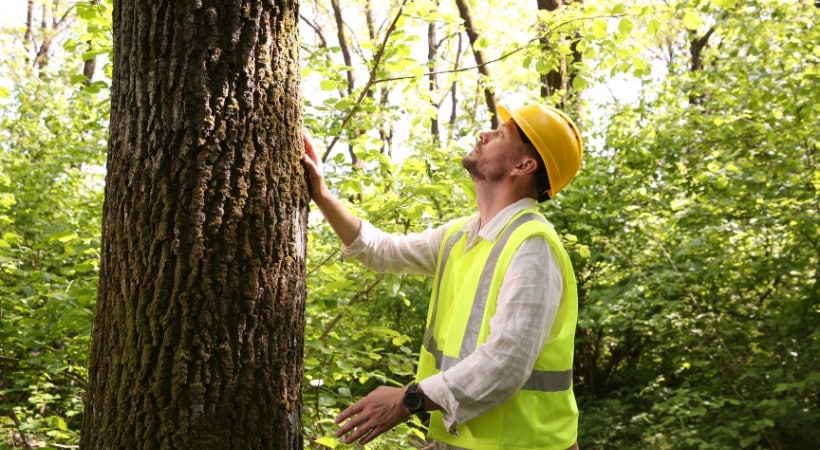
A Licensed Tree Expert evaluates trunk soundness, canopy health, and surrounding targets before recommending cabling, bracing, or removal.
Protect the Trees That Define Your Property with A-AAA Tree Service
If your property has a mature tree with a V-shaped union, visible crack or a long heavy limb stretched over a roof or driveway, it is worth having it looked at before the next major storm. A-AAA Tree Service holds three Maryland Licensed Tree Expert licenses and has served the greater Baltimore area for over two decades, offering both tree cabling and bracing for trees that can be preserved and removal for those that can’t.
Request a proposal online or call us today at 410-321-0921 to find out what is right for your tree.

After a 31-year career as a special education teacher in Baltimore County Public Schools, Marcee retired in 2025 to focus full time on A-AAA Tree Service. Having spent two years learning the business before her retirement, she now plays an active role in the company’s operations and customer care.
Related Articles
Should I Grind a Stump or Leave It?
Not sure whether to grind that stump or leave it alone? Learn the risks, the decision points, and how A-AAA handles stump grinding in greater Baltimore.
How to Tell If a Tree Is Dead or Just Stressed
A bare or thinning tree in a Baltimore-area summer may be stressed, not dead. Learn how to tell the difference and when to bring in a Licensed Tree Expert.
What Should You Do When a Tree Is Damaged in a Storm?
A storm hit your Baltimore County trees. Learn which damage is an emergency, which can wait, and when to request a proposal with a Licensed Tree Expert.
