In the older, wooded neighborhoods throughout Pikesville, Owings Mills, and Reisterstown, a large oak or maple tree is usually as old as the house. If that sounds like your property and you need tree trimming, the best time to trim trees in Maryland is late winter, while trees are dormant. That means you should book the work before the window opens.
Mature trees don’t recover from heavy cuts as well as young ones, so the amount removed is just as important as when it’s removed. Taking too much live canopy in one season can start a decline that doesn’t show for a few seasons, and a tree this old can’t be replaced.
Key Takeaways
- Late winter, while the tree is dormant, is the best time to prune large trees in Maryland, so book before that window opens.
- Maryland’s Department of Natural Resources Forest Service recommends removing no more than 25 percent of a mature tree’s foliage per growing season, and many old trees tolerate less.
- Large reduction cuts over 2 inches on main scaffold limbs should be avoided, and topping and lion-tailing should be ruled out.
- A wrong call can show up seasons later as water sprouts, tip-heavy limbs, and slow canopy decline.
- Ask to see a Licensed Tree Expert’s license card and get a written plan before anyone prunes an old tree.
Why Does Pruning Timing Advice Sound So Inconsistent?
For the most part, pruning advice online is written for young ornamentals, flowering shrubs, and fruit trees. The rules differ for each, too. The guidance from the University of Maryland Extension favors the dormant season for most trees and shrubs, while treating plants like hydrangeas and fruit trees as exceptions and stating dead or diseased wood can come off whenever it’s found.
Large shade trees are a different case because heavy cuts are slow to recover from and hard to undo. That’s why dormant-season pruning is the standard for mature trees, and why this guide focuses on them.
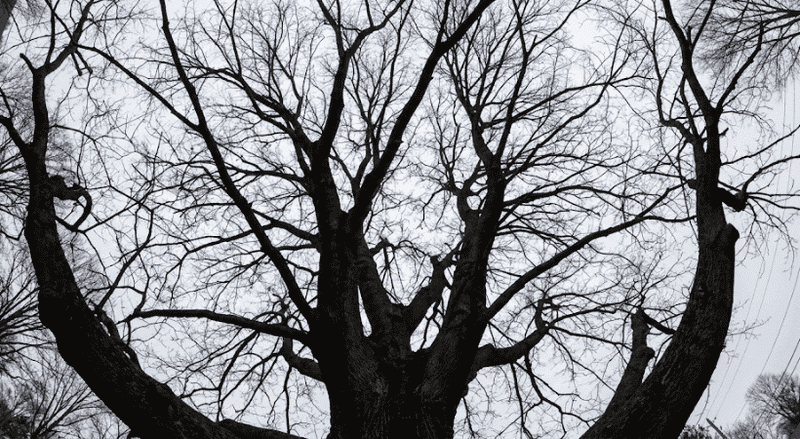
Bare limbs in late winter make a tree’s structure easy to read before any cuts are made.
When Is the Best Time to Prune Large Trees in Maryland?
In late winter, while the tree’s dormant, is the best time to prune large trees in Maryland, since it’s before spring growth starts. Dormancy helps a large tree in a few ways:
- Visibility: A bare tree lets the pruner see the whole structure and judge how each cut will change its shape.
- Faster Sealing: Insects and disease organisms are dormant, and wound response picks up early in the growing season, so late-winter cuts stay open for less time.
- No Frost-Killed Shoots: Pruning before full dormancy can trigger new shoots that cold temperatures kill.
November to March is roughly when dormancy runs, but the strongest part of it is late winter. That’s why homeowners along the Reisterstown Road corridor in northwest Baltimore County should book in the fall or early winter. Our seasonal tree trimming guide breaks down the rest of the year.
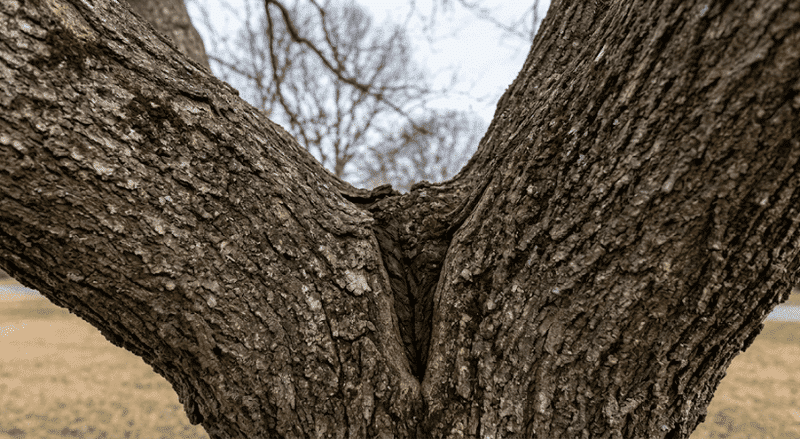
A narrow V-shaped union with trapped bark is a defect a trained eye can tell apart from one that needs support.
What Does Dormant Pruning Involve for a Mature Tree?
Before anything else, the tree is assessed. Then, it moves to targeted cuts instead of a general, tree-wide trim. A Licensed Tree Expert can take a clear look at the tree’s structure, pruning history, species, age, and condition and set clear objectives prior to cutting. That goes for the oaks, maples, tulip poplars, and pines common across Pikesville, Owings Mills, and Reisterstown.
The work itself generally combines four types:
- Cleaning: Removes dead, diseased, detached, and broken branches
- Thinning and Sprout Management: Brings in light and airflow and controls water sprouts
- Crown Reduction: Shortens a limb back to a side branch large enough to take over as the new tip, and is used with care because not every tree tolerates it
- Conifer Care: Keeps work on pines mostly corrective, since cutting conifers back to older wood with no foliage usually kills the stub
Structure pruning is mainly for young and medium-aged trees. For an old tree, the goal is managing the structure that already exists. Branches with a V-shaped attachment and included bark (when bark gets trapped and compressed between competing branches) are the ones to remove, but a codominant stem with that kind of union may need cabling and bracing for mature trees instead. A trained eye can differentiate the two.
If a tree can’t be saved and needs to be removed, our guide to the signs that point toward tree removal thoroughly covers that conversation.
How Much Can a Decades-Old Tree Tolerate?
A mature tree shouldn’t lose more than 25% of its foliage in a growing season, and many old trees can tolerate less. So, that figure should be viewed as the ceiling and not a target or safe amount. How much less a particular tree can take depends on its species, health, and pruning history, and a Licensed Tree Expert should be the one to make that call.
As a homeowner, it’s important to know what should be avoided on an old tree:
- Large Reduction Cuts: Those over 2 inches in diameter on permanent scaffold limbs should be avoided.
- Topping: It’s an unacceptable practice because it increases the risk of failure.
- Lion-Tailing: Stripping interior branches reduces branch taper, can sunburn bark, and weakens branch structure.
- Large Wounds: They take longer to seal, which gives decay a way into an aging tree.
Our guide to the signs a tree needs trimming explains what to point out when you ask for a plan.
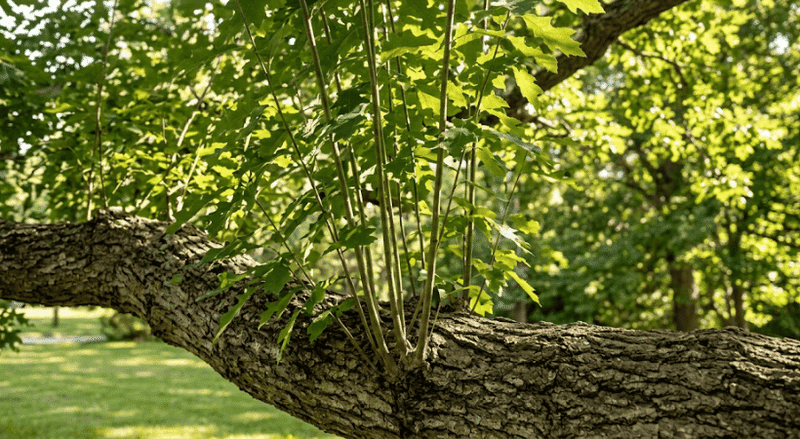
Fast, weakly attached water sprouts are one sign that too much was removed in a single season.
What Happens Seasons Later If the Call Is Wrong?
A heavily pruned tree can normally leaf out the next spring while it draws on stored energy, so the cost tends to go unnoticed at first. Over the following seasons, three signs can build:
- Water Sprouts: Fast regrowth attaches only superficially and is structurally weak.
- Tip-Heavy Limbs: Interior thinning can leave over-extended branches more likely to fail in wind.
- Slow Canopy Decline: Excessive pruning can upset the balance between canopy and roots and start a multi-year decline.
Making the wrong call on an old tree isn’t something that’s easily undone, which is why spreading heavy work over a few seasons is a normal expectation. Before anyone prunes your tree, ask to see their license card and confirm that topping and lion-tailing are out of the question.
Frequently Asked Questions About Pruning Mature Trees
Can you schedule routine pruning in summer or fall?
No. In summer and fall, our crews limit work to hazard cuts such as dead or damaged branches, and routine pruning waits for dormancy.
What should a written pruning plan include?
A written plan should state the objective, the type of pruning, where the cuts go, and the size range of the parts removed. Ask for the percentage of live foliage coming off as well.
Should pruning cuts be sealed?
Usually not. Wound treatments should not be used except for specific reasons, because trees seal their own wounds.
How often do mature trees need pruning?
There is no fixed schedule, because it depends on the species, the tree’s condition, and the type of pruning done. Crown reduction increases the time before pruning is needed again compared with topping.
Does it matter whether the crew pruning my tree is licensed?
Yes.Only Maryland Licensed Tree Experts can lawfully be hired to trim branches or remove trees.
Schedule Your Late-Winter Pruning With A-AAA Tree Service Today
A decades-old oak or maple deserves a written plan that states what comes off and why, from a Licensed Tree Expert who can clearly explain every cut. To get your tree on the late-winter schedule, request a proposal today for our tree trimming services in the greater Baltimore area.

After a 31-year career as a special education teacher in Baltimore County Public Schools, Marcee retired in 2025 to focus full time on A-AAA Tree Service. Having spent two years learning the business before her retirement, she now plays an active role in the company’s operations and customer care.
Related Articles
Tree Inspection Before Winter in Baltimore
A tree inspection before winter shows what bare branches reveal. See what a Licensed Tree Expert checks and what happens next for Baltimore homeowners.
Should I Grind a Stump or Leave It?
Not sure whether to grind that stump or leave it alone? Learn the risks, the decision points, and how A-AAA handles stump grinding in greater Baltimore.
How to Tell If a Tree Is Dead or Just Stressed
A bare or thinning tree in a Baltimore-area summer may be stressed, not dead. Learn how to tell the difference and when to bring in a Licensed Tree Expert.