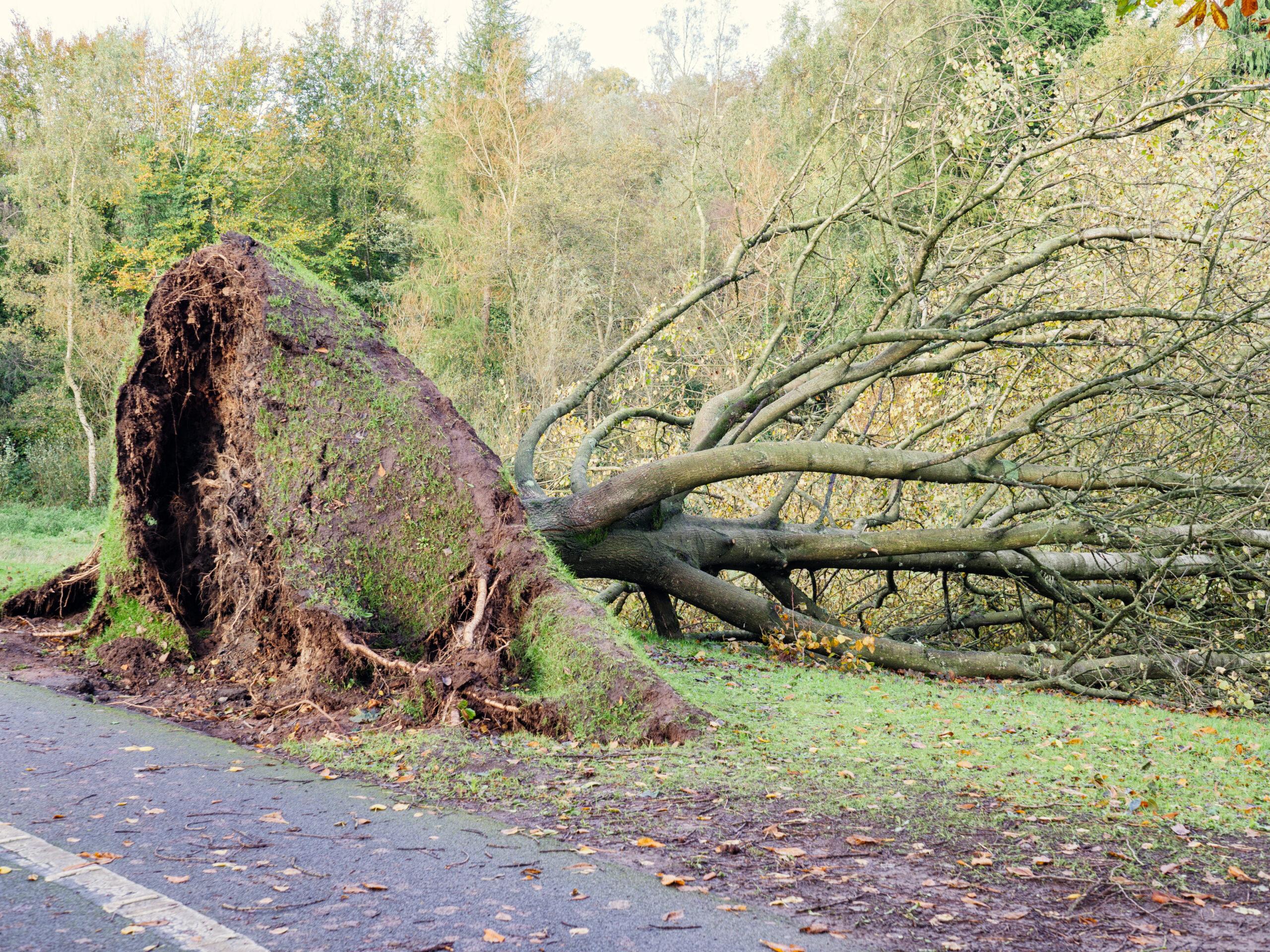
When a winter storm hit the greater Baltimore area in January 2026, the primary threat was snow and ice piling up on power lines and trees. Falling trees and limbs cause about half the power outages in major storms, so a tree inspection before winter is the time to find weak points that can give way under snow and ice.
Weak points like co-dominant stems, included bark, and early decay are hard to see from your yard. That means the stakes are highest when mature trees hang over a house, driveway, or power line.
Key Takeaways
- A Maryland Licensed Tree Expert checks for co-dominant stems, included bark, and early decay that a quick look from the ground can miss.
- Leaf-off canopies expose deadwood, cracks, and weak unions before ice and snow add load to limbs over roofs, driveways, and lines.
- A mature tree over a roof, driveway, or power line, or a fresh crack, hanging limb, or worsening lean, is a sign a tree is due for an evaluation.
- An evaluation ends in one of four outcomes (monitor, prune, cable and brace, or remove), and removal is the last option, not the default.
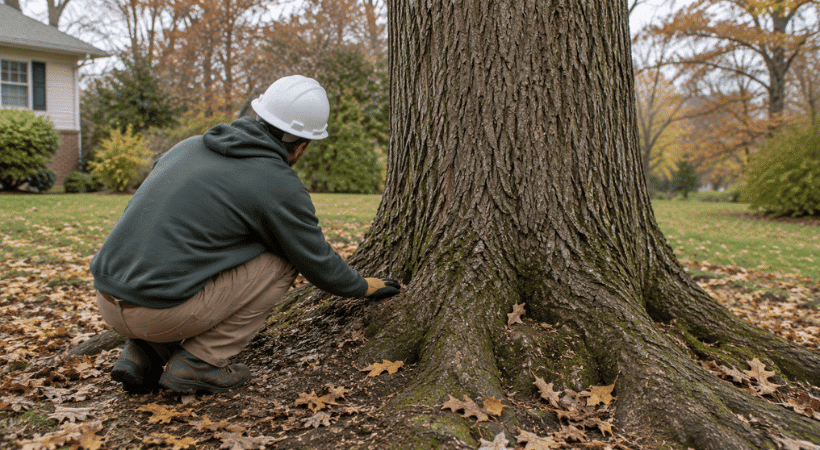
A ground-level look at the trunk base and root flare helps catch early decay and girdling roots.
Is a Tree Inspection Before Winter Worth It?
Yes, especially somewhere between leaf drop and the arrival of the first ice or snow, since bare branches expose deadwood, cracks, weak unions, and co-dominant stems normally hidden by foliage. There are three questions to keep in mind to determine whether your trees are due for an inspection:
- Is a mature tree growing over or near your roof, driveway, or a power line?
- Have you noticed fresh cracks, hanging limbs, exposed roots, a soil mound on one side of the trunk, or a lean that is getting worse?
- Has a Maryland Licensed Tree Expert evaluated the tree recently?
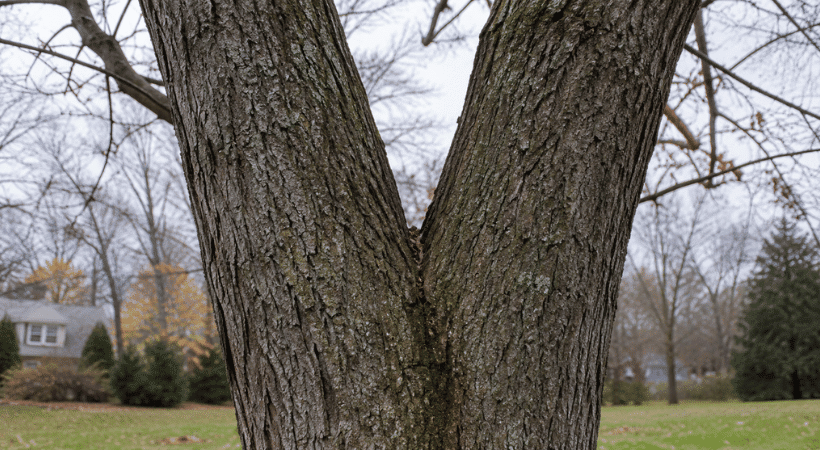
Co-dominant stems with included bark are weakly attached, and they are easy to miss from the ground.
What Does a Maryland Licensed Tree Expert Catch That Others Would Miss?
A Maryland Licensed Tree Expert catches the structural and hidden defects, such as:
- Co-dominant stems are two stems of similar diameter growing from the same point, and they are often weakly attached.
- Included bark is bark that grows inside the union between stems and can look like a crack to an untrained eye.
- Early decay and root flare problems, such as girdling roots, are checked at the base of the tree.
What Does a Professional Tree Evaluation Include?
A professional tree evaluation includes a structured assessment of each tree’s defects, the targets beneath it, and the options for lowering the level of risk. A “target” is anything that a failing limb or tree could hit, such as a house, vehicle, or person. That’s why the same defect can be a low priority when it’s over an open lawn but a higher one when it’s over a roof.
The International Society of Arboriculture (ISA) defines three levels of assessment:
- Level 1 is a limited visual assessment.
- Level 2 is a basic assessment.
- Level 3 is an advanced assessment, used when a basic one finds issues that need more detail, because a ground-based evaluation cannot see everything.
What Happens After the Evaluation?
After the evaluation, you’re left with a plan for lowering each tree’s risk, starting with the highest risk found. The plan also estimates the risk that would remain after the work, so every option can be compared on what it would achieve.
Each tree typically lands in one of a few possible outcomes:
- A stable tree is monitored, and the assessment includes a recommended reassessment interval, so monitoring is a plan with a follow-up, not a decision to ignore the tree.
- A tree with correctable problems is pruned, and routine structural pruning is best planned for the dormant season.
- A tree with a manageable structural weakness may be supported with cabling and bracing, which is designed to reduce the risk of failure, not eliminate it.
- A tree whose risk cannot be reduced by any other option is a candidate for removal.
Even when removal’s on the table, it’s weighed against what the tree provides, like wildlife habitat and shade. For trees that stay, conditions change over time, so a second look after an unusually severe storm is worth it.
Why Does the License Behind the Visit Matter?
Only Maryland Licensed Tree Experts can legally trim branches and remove trees for hire in the state, and they must carry insurance that covers tree work. Unlicensed operators may display fraudulent license numbers or falsely claim to be bonded and insured, so their opinion can come with no real protection for your property. For a more in-depth explanation of t he risks of hiring the wrong crew, check out our post.
It only takes a few minutes to verify a license, so ask to see it, check the license number on the Department of Natural Resources website, and look for the number on the vehicle.
Frequently Asked Questions About Tree Inspections
Does a winter inspection replace a spring check?
No. A bare tree cannot show foliage health, and leaf-on is when a thin or discolored canopy shows up.
Does a mushroom growing on a tree mean it has to come down?
Not automatically. Fungal fruiting bodies such as mushrooms or conks usually mean the decay involved is already advanced, which is why they call for an evaluation rather than a guess. What happens next depends on the tree’s condition and what sits beneath it.
What should I do if I notice a change in a tree before my evaluation?
Keep people and vehicles away from the area beneath the tree, and request a proposal promptly. Do not climb the tree or try to cut down a hanging limb yourself, because a limb that has already shifted can fall while you are working beneath it.
How can I show a Licensed Tree Expert what has changed in a tree?
Take a dated photo of the base, trunk, and crown from the same spot each time. A series of photos shows what has shifted over time, something a single visit can’t capture.
Is every leaning tree dangerous?
No. Trees lean for different reasons, and a lean that has been stable for years is not the same as one that is changing. Hardwoods form tension wood on the upper side of a lean or bend, where it pulls the stem upright, so reading a lean takes more than a glance.
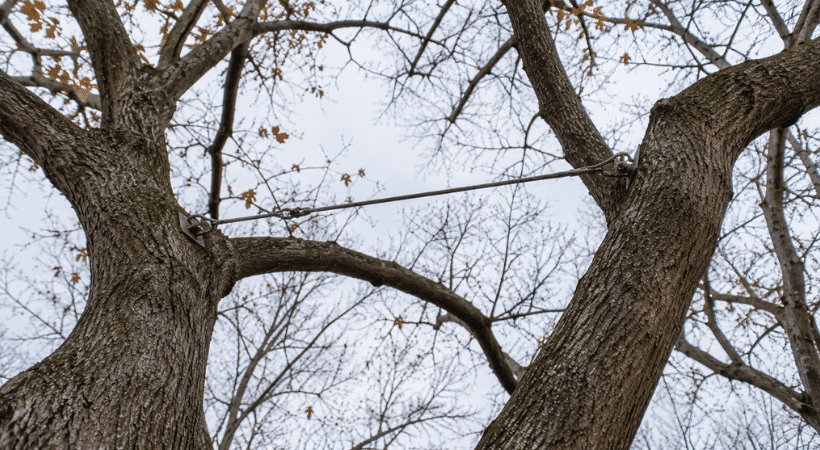
Cabling and bracing can reduce the risk of failure in a tree with a manageable structural weakness.
Book an Inspection From the Tree Experts at A-AAA Tree Service
A Maryland Licensed Tree Expert from A-AAA Tree Service can tell you which of your trees (if any) need attention, so be sure to get your tree inspection scheduled while the branches are still bare. Request a proposal online today to get started.

After a 31-year career as a special education teacher in Baltimore County Public Schools, Marcee retired in 2025 to focus full time on A-AAA Tree Service. Having spent two years learning the business before her retirement, she now plays an active role in the company’s operations and customer care.
Related Articles
Should I Grind a Stump or Leave It?
Not sure whether to grind that stump or leave it alone? Learn the risks, the decision points, and how A-AAA handles stump grinding in greater Baltimore.
How to Tell If a Tree Is Dead or Just Stressed
A bare or thinning tree in a Baltimore-area summer may be stressed, not dead. Learn how to tell the difference and when to bring in a Licensed Tree Expert.
What Should You Do When a Tree Is Damaged in a Storm?
A storm hit your Baltimore County trees. Learn which damage is an emergency, which can wait, and when to request a proposal with a Licensed Tree Expert.